Clinton County Dog Registration Information
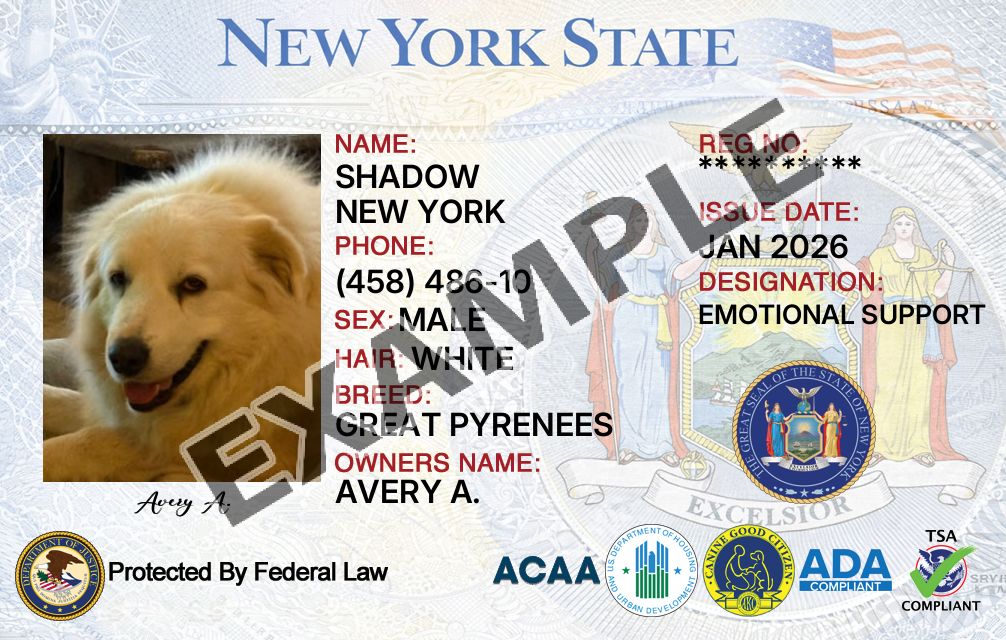
Service Dogs and Emotional Support Animals in Clinton, New York
If you’re asking, “where do I register my dog in Clinton County, New York for my service dog or emotional support dog”, the key thing to know is that “registering” usually means getting a local dog license. In Clinton County, most dog licensing is handled by your city, town, or village clerk (the municipality where you live), not by a private registry and not usually by a single countywide licensing office.
This page explains how a dog license in Clinton County, New York typically works, what rabies paperwork you’ll need, and how licensing differs from service dog legal status and emotional support animal (ESA) rules—so you can get the right documents from the right office.
Where to Register or License Your Dog in Clinton County, New York
Because licensing is handled locally, you will typically contact the city or town clerk where you reside. Below are several example official offices within Clinton County, New York that provide dog licensing information or dog control coordination. If your municipality is not listed, look for your specific Town Clerk or Village Clerk office.
Example Municipal Licensing Office (City)
City of Plattsburgh — City Clerk (Dog Licenses)
This is a good example of how city residents may license through their city clerk. If you live outside city limits, your town clerk is usually the right place to start.
Example Municipal Licensing Office (Town)
Town of Plattsburgh — Town Clerk (Dog Licensing & Dog Control Contact)
Town offices often coordinate both the animal control dog license Clinton County, New York process and local dog control calls. If you are unsure whether you are in the City of Plattsburgh or the Town of Plattsburgh, ask the clerk based on your address.
Example Municipal Licensing Office (Town)
Town of Dannemora — Town Clerk/Tax Collector (Dog Licenses)
This is an example of a town clerk page that explicitly lists dog licenses as a clerk service and provides posted window hours. Always confirm current hours before visiting.
County-Level Rabies & Public Health (Not Dog Licensing)
Clinton County Health Department (Rabies Guidance, Clinics & Bite Reporting)
The Health Department is commonly involved in rabies enforcement and public health response (for example, bite reporting and vaccination clinic information). For the actual dog license tag, you usually start with your local clerk.
Overview of Dog Licensing in Clinton County, New York
What “registering” a dog usually means
In everyday language, “registering” a dog often refers to getting a local dog license. A license is a government-issued record that connects your dog to you (the owner) and typically provides an official tag number. This helps animal control and shelters identify a lost dog quickly, and it helps municipalities confirm compliance with public health rules such as rabies vaccination requirements.
Who issues a dog license in Clinton County, New York?
For most residents, the correct office is the licensing clerk in the municipality where you live—commonly your Town Clerk or City Clerk. That’s why you may see different instructions and fees depending on whether you live in a city, town, or village within Clinton County.
Why licensing still matters for service dogs and ESAs
A service dog or an emotional support animal can still be subject to the same local licensing and rabies rules as other dogs. In other words: licensing is about animal identification and public health, while service dog/ESA status is about housing, access, and disability-related accommodations.
How Dog Licensing Works Locally in Clinton County, New York
Step 1: Find your local licensing clerk
Start by confirming which municipality you live in. Many addresses in Clinton County are near Plattsburgh, but residents may be inside the City of Plattsburgh limits or in the surrounding Town of Plattsburgh (or in another town/village). Your dog license is typically issued by the clerk for your municipality, not by an online registry.
Step 2: Bring required documents (rabies + spay/neuter, if applicable)
Municipal clerks commonly require proof of current rabies vaccination and may ask for proof of spay/neuter status, because many communities have different fees or categories. If your dog is newly vaccinated, keep the veterinarian-issued rabies certificate handy.
Step 3: Pay the fee and receive a tag
After you apply and pay the licensing fee, the clerk issues a license record and an official tag number. The tag is typically meant to be attached to your dog’s collar. Your municipality may issue annual renewals and reminders.
Rabies vaccination requirements and enforcement
Rabies vaccination is a core requirement tied to dog licensing throughout New York. In Clinton County, the Health Department plays a central role in rabies-related public health— including guidance, clinics, and bite reporting—while the local clerk issues the license. If there is a bite incident or a possible exposure concern, public health authorities may require documentation or specific steps to protect people and animals.
Service Dog Laws in Clinton County, New York
Service dogs are defined by training and disability-related work
A service dog is generally a dog that is individually trained to do work or perform tasks for a person with a disability (for example, guiding, alerting, mobility support, psychiatric task work, or medical alerts). What makes the dog a service dog is the trained task(s) that mitigate a disability—not a license tag and not a purchased “certificate.”
Does a service dog need a “service dog registration” to be legal?
Typically, no. There is no universal government “service dog registry” required for public access. However, your dog may still need a dog license in Clinton County, New York through your local clerk—because licensing is about identification and rabies compliance.
Local licensing vs. service dog status (how they fit together)
Think of these as two different tracks:
- Dog license: Issued by your municipality; tied to rabies proof and identification tags.
- Service dog status: Tied to disability and trained tasks; not created by a municipal license.
Emotional Support Animal Rules in Clinton County, New York
ESAs are not the same as service dogs
An emotional support animal (ESA) is generally an animal that provides comfort or support that helps with a person’s disability, but the animal is not necessarily trained to perform specific tasks the way a service dog is. This difference affects where the animal may be allowed and what rules apply.
Housing accommodations are different from public access
ESA rules most often come up in housing. A landlord may need to consider a reasonable accommodation for a tenant with a disability-related need for an ESA (depending on the housing type and applicable laws), but an ESA is not automatically treated as a service animal for entry into all public places.
Do ESAs still need local licensing and rabies vaccination?
Yes in most cases. If your ESA is a dog living in the county, it generally still needs to follow local licensing rules, including current rabies vaccination documentation. If you’re trying to figure out where do I register my dog in Clinton County, New York for my service dog or emotional support dog, the answer for the “registration” part is still the same: your local municipal clerk for the dog license.
Frequently Asked Questions
Disclaimer
Licensing requirements and office locations may change. Residents should verify details with their local animal services office within Clinton County, New York.
Register A Dog In Other New York Counties
Select your county below to get started with your dog’s ID card. Requirements and license designs may vary by county, so choose your location to see the correct options and complete your pup’s registration.
- Albany County Dog Registration
- Allegany County Dog Registration
- Bronx County County Dog Registration
- Broome County Dog Registration
- Cattaraugus County Dog Registration
- Cayuga County Dog Registration
- Chautauqua County Dog Registration
- Chemung County Dog Registration
- Chenago County Dog Registration
- Columbia County Dog Registration
- consolidated borough-county government County Dog Registration
- Cortland County Dog Registration
- Delaware County Dog Registration
- Dutchess County Dog Registration
- Erie County Dog Registration
- Essex County Dog Registration
- Franklin County Dog Registration
- Fulton County Dog Registration
- Genesee County Dog Registration
- Greene County Dog Registration
- Hamilton County Dog Registration
- Herkimer County Dog Registration
- Jefferson County Dog Registration
- Kings County County Dog Registration
- Lewis County Dog Registration
- Livingston County Dog Registration
- Madison County Dog Registration
- Monroe County Dog Registration
- Montgomery County Dog Registration
- Nassau County Dog Registration
- New York County County Dog Registration
- Niagara County Dog Registration
- Oneida County Dog Registration
- Onondaga County Dog Registration
- Ontario County Dog Registration
- Orange County Dog Registration
- Orleans County Dog Registration
- Oswego County Dog Registration
- Otsego County Dog Registration
- Putnam County Dog Registration
- Queens County County Dog Registration
- Rensselaer County Dog Registration
- Richmond County Dog Registration
- Rockland County Dog Registration
- Saratoga County Dog Registration
- Schenectady County Dog Registration
- Schoharie County Dog Registration
- Schuyler County Dog Registration
- Seneca County Dog Registration
- St. Lawrence County Dog Registration
- Steuben County Dog Registration
- Suffolk County Dog Registration
- Sullivan County Dog Registration
- Tioga County Dog Registration
- Tompkins County Dog Registration
- Ulster County Dog Registration
- Warren County Dog Registration
- Washington County Dog Registration
- Wayne County Dog Registration
- Westchester County Dog Registration
- Wyoming County Dog Registration
- Yates County Dog Registration